The case for flat tax
Published:
My tax situation in 2024 was very complicated due to a job change, a move, and a Roth conversion, among other factors. While filing for taxes, I studied part of the tax code. I discuss my thoughts here.
The figure below shows the 2025 marginal tax rate schedule. The tax brackets for those married filing jointly are about twice as large as those of single filers.
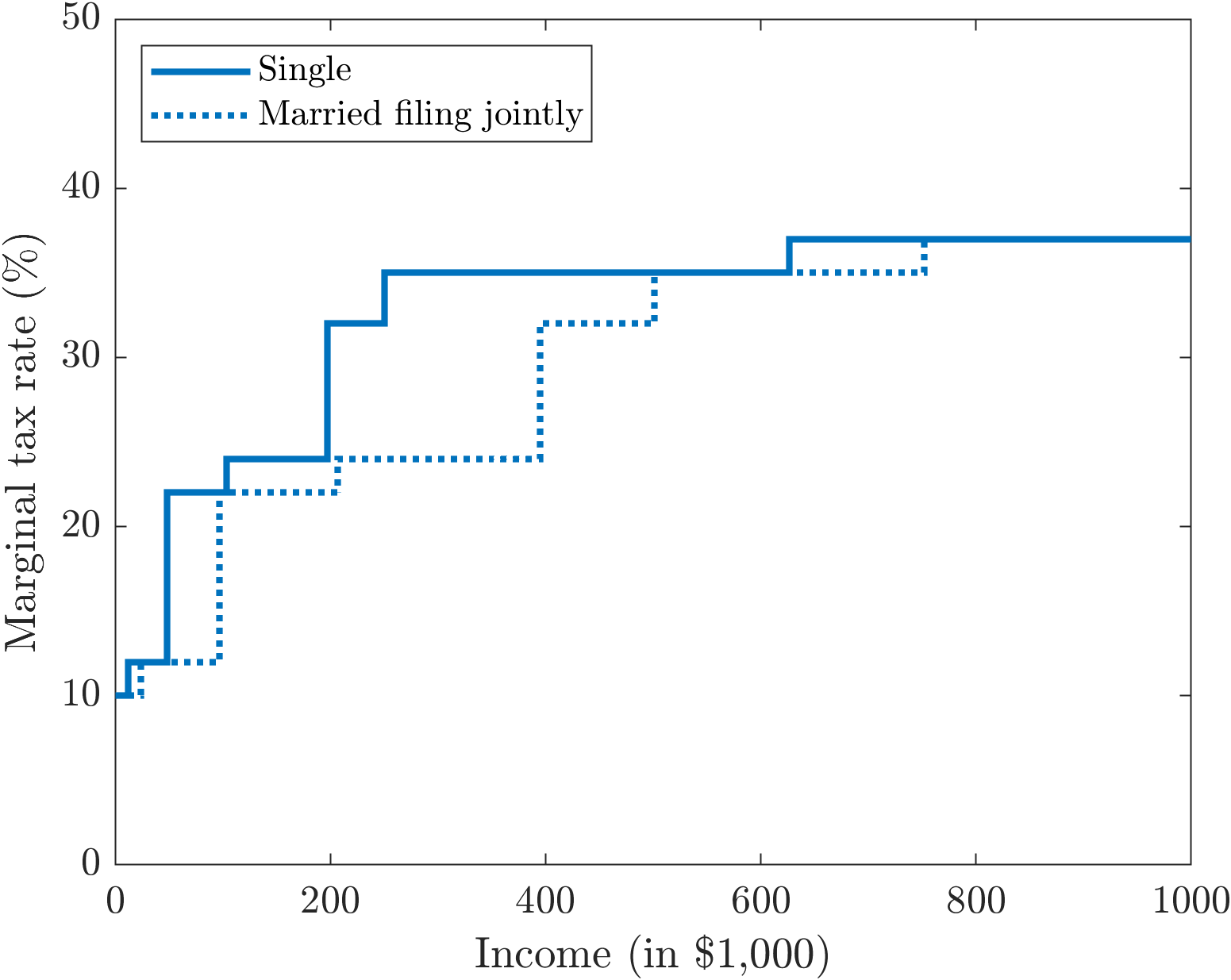
The United States tax code and various regulations are extremely complicated. This complexity induces high-tax individuals (i.e., high-income individuals, because the income tax is progressive) to engage in legal tax-avoiding behavior. While the government may raise high tax revenues by fine-tuning the system, we should also not forget the waste it creates from maintaining the tax agency, imposing compliance costs on taxpayers, and distorting talent (some individuals may seek employment in tax advisory roles instead of other industries). In my opinion, our lives would be much simpler if tax rates were flat (accompanied by a generous standard deduction or even a fixed transfer to support low-income individuals) and there were only one filing status (individual).
Let’s do a quick back-of-the-envelope calculation. In 2023, total personal income in the United States was about $23 trillion (Bureau of Economic Analysis, National Income and Product Accounts, Table 2.1, line 1), personal income tax revenue was $2.24 trillion (which is about half of total tax revenue), and the adult population (those with age 18 or older) was 262 million. Suppose that to alleviate poverty, we would like to give every adult the poverty guideline for singles of $1,300 per month, or $15,600 per year, no strings attached (which can be easily implemented by connecting payments with social security numbers). What is the necessary flat tax rate to support the same income tax revenue and the transfer? The answer is
\[\frac{2.24\times 10^{12} + 15600 \times 262 \times 10^6}{23 \times 10^{12}} = 27.5\%.\]
The figure below shows the total tax liability for individuals under the current tax system and the alternative flat-tax system.
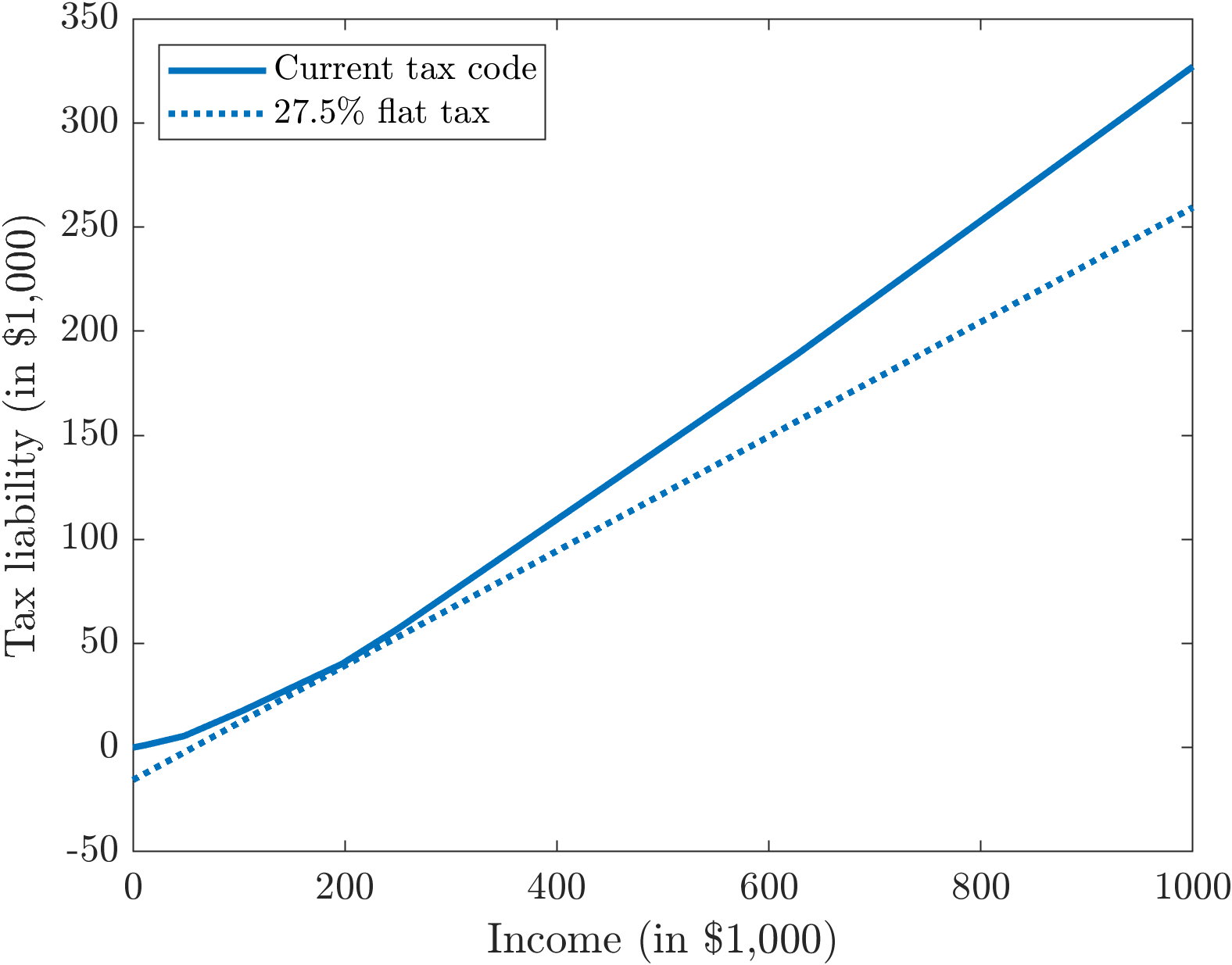
I am not suggesting that this flat-tax system is optimal. However, it is mind-blowing that if 27.5% of what we earn is automatically withheld as tax, we don’t need the Internal Revenue Service (IRS), food stamps, or tax advisors, and yet we can all receive $1,300 per month and still support the current government spending. Furthermore, according to the figure above, everyone will owe less tax than under the current system. This may sound contradictory, as we maintained the same total tax revenue, but it is not. The reason is that the figure assumes income is ordinary income, whereas in reality, total income is a combination of ordinary and capital income. The majority of wealthy individuals’ income is capital income, which is currently taxed at 20%. If we move to a flat tax of 27.5%, the tax liability of capital owners will increase.
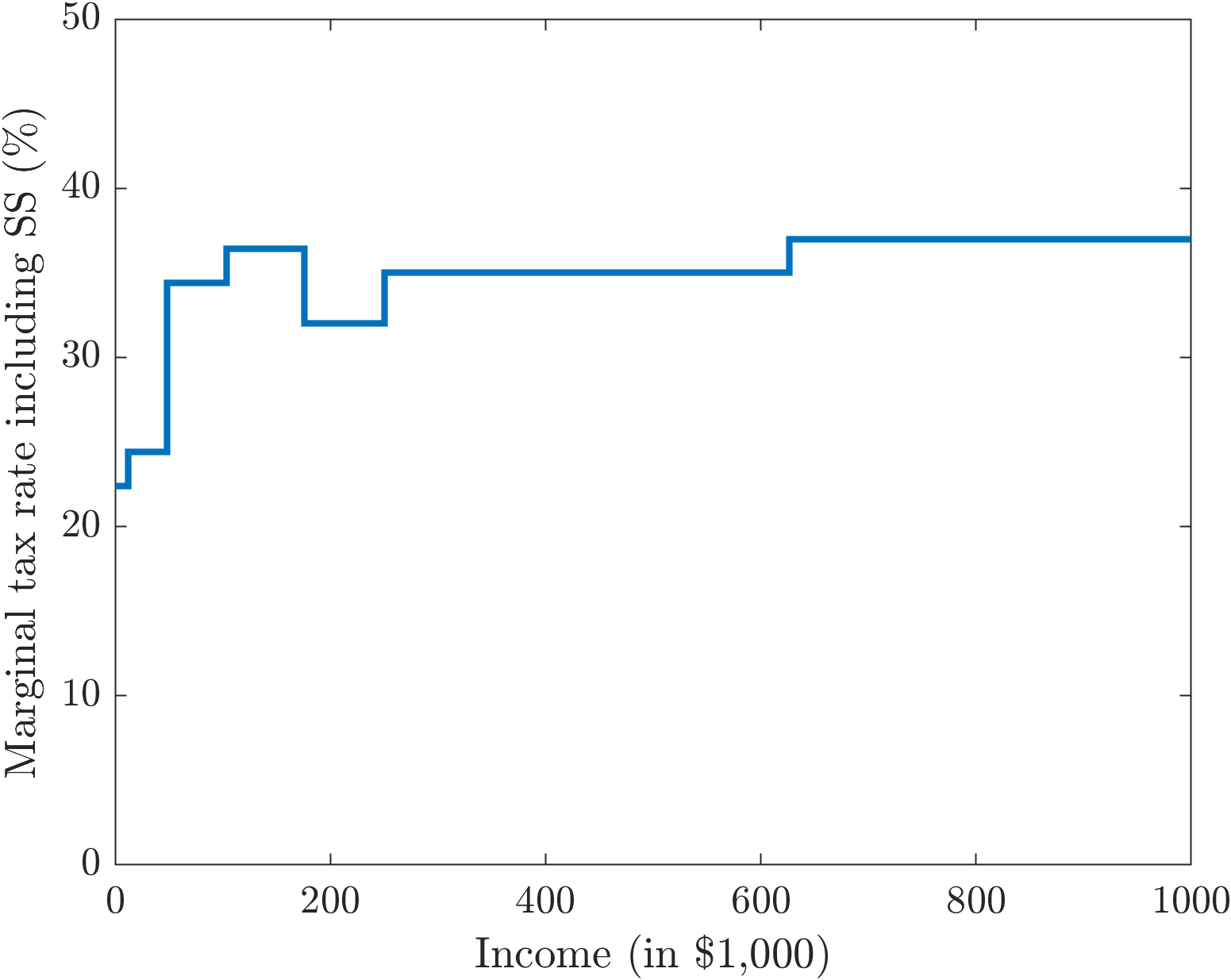
But this is not the end of the story. In addition to personal income tax, the federal government imposes a 12.4% Social Security tax (including contributions from both the employer and the employee) on salary and wages up to $176,100 to support Social Security. The personal income tax and the social security tax account for about 85% of federal tax revenue. (The corporate income tax revenue is about 11%, and revenues from estate tax, gift tax, and tariffs are minuscule.) If we add this social security tax to the personal income tax, the individual marginal tax rate becomes as shown in the figure below. Interestingly, the marginal tax rate is no longer progressive but is nearly flat at around 37% except for low-income individuals.
The average Social Security paycheck is about $2,000 per month. Suppose that, instead of giving every adult $1,300 per month, we give $2,000 per month ($24,000 per year) to those aged 65 or over (while maintaining $1,300 per month for those under 65), and abolish the social security system. In 2023, the population of 65 or over was about 59 million. The necessary flat tax rate to support the same income tax revenue and the transfers now changes to
\[\frac{2.24 \times 10^{12} + 15600 \times 203 \times 10^6 + 24000 \times 59 \times 10^6}{23 \times 10^{12}} = 29.7\%.\]
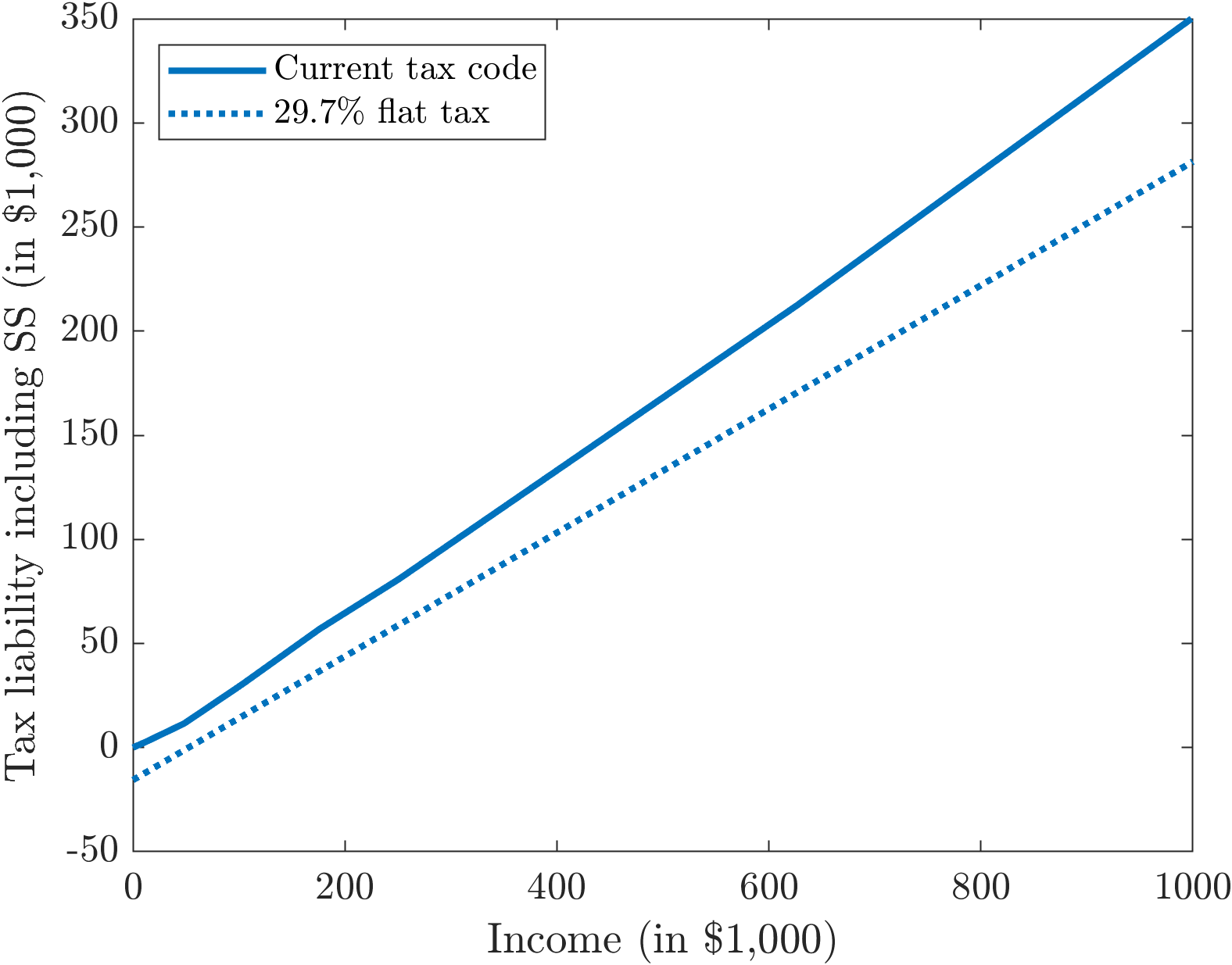
The figure below shows the tax liability, including the social security tax, for those under 65. Again, it is mind-blowing that if 30% of what we earn is automatically withheld as tax, we all pay less tax, we don’t need the IRS, food stamps, tax advisors, or social security, and we can still support the current government spending.